|
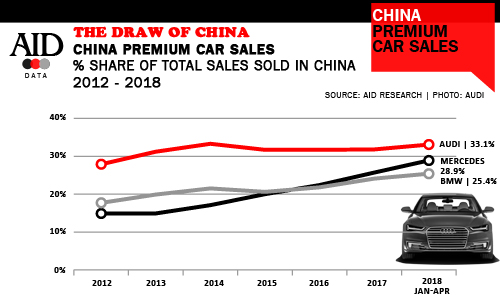
China’s decision to counter threats of a potentially deeply damaging trade war with the US has ostensibly sparked a surprise Chinese move to cut its import tariff for fully assembled cars from 25% to 15% from July 1 this year
The commercial significance of this milestone move is driven home by figures showing that last year around a third of the cars sold in China by Mercedes and BMW were imported.
In contrast, spurred into action by China’s historically high tariffs on imported cars, the proportional sales share of locally built cars has progressively risen in straight-line manner.
Last year, China-built cars already accounted for the lion’s share of prestige sector car sales in China.
In the case of Mercedes and BMW for example, around two-in-three of their Chinese car sales were already locally built at their Chinese joint-venture car plants.
In the case of BMW for instance that compares with 2010, when the exact opposite was still the norm.
That’s in the sense that in 2010 some 115,300 of the 169,000 cars sold by BMW in China were still imported.
In contrast, last year locally built cars were responsible for 384,400 of BMW’s 594,400 sales in China.
That’s to say that since 2010 the sourcing patterns were reversed.
Today, partly as a result of China’s high 25% vehicle import tariff, two-in-three cars sold in China last year by BMW and Mercedes were built at local Chinese car plants.
You
are just reading a summary of the full article available in the AID
Newsletter full subscription version. With a full
subscription you can download the current edition to read on any
digital device or receive the latest edition as a traditional print copy.
Or if you would like to receive a trial
edition simply send us your details.
MORE
PRODUCTION
ARTICLES
LIKE THIS:
|
Majority of cars built by Mercedes are no longer ‘Made in Germany’ 13
Apr 2018
|
Return of consumers’ appetite
kept some of world's car production near full throttle 22
Mar 2018
|
Germany’s car exports to China dwarfed by UK 7
Feb 2017
|
