|
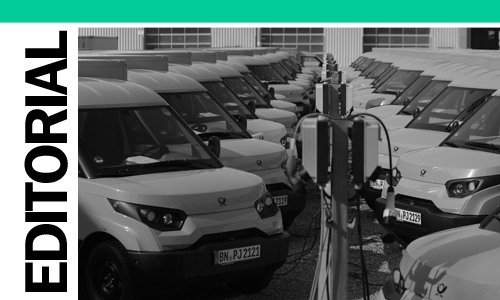
"To do your own thing in the complex vehicle manufacturing business hardly ever works. So what chance is there that Deutsche Post DHL, engineering and building its own electric light-commercial vehicle - will make it pay?
Working within the autoindustry and looking out, product planners and product strategists all believe to have seen the future. It’s probably safe to say that most of them, looking at the future West European vehicle market, are seeing a gradual switch to electric propulsion.
That’s particularly for air-pollution sensitive inner cities.
This segment, electrically powered commercials and taxis, could be profitable well before electric cars.
All well and good. The problem with electric vehicle forecasts is however, the blatant absence of an agreed definition for when exactly that ‘New Age’ electric vehicle future starts.
Some see it as early as 2020, others from 2025 or even 2030.
There is no way of knowing for sure.
Whatever assumption is made, judged entirely on published news, the New Age vehicle future, powered principally by Volts rather than Octane, meant electrically powered cars capable of travelling purely on electric power for at least 50km or so.
However, apart from perhaps abstract thoughts it seems, until fairly recently little was done about electrically powered vans capable of making pure economic sense.
That’s not in 2025 or 2030, but in today’s cut-throat commercial world.
The question is whether there is a commercially viable market for electric light commercials today?
Geely’s Coventry based LEVC operation thinks so and has already installed capacity for 10,000 e-Powered taxis and same base LCVs, rising to 20,000 by 2022.
Well, now we know there is another.
Germany’s huge postal operation said the autoindustry was not interested in its requirement.
Therefore it was left with no choice but to design and build its own fully electric van range.
That it has done.
Today Deutsche Post DHL Group says it is already using around 6,000 of these electric vehicles, which so far have covered over 26 million kilometres.
Evidently, other commercial operators have shown interest and Deutsche Post’s latest doubling in StreetScooter production capacity speaks volumes.
This Wednesday its second StreetScooter assembly plant started production.
The new facility, working with just one shift, is capable of building 10,000 of its own electric vans, chassis cabs and drive-away front ends.
With two plants operational that’s 20,000 units a year.
Evidently more than it needs.
To no one’s real surprise, the autoindustry is lost for words. Apart from Ford, which will service these StreetScooters.
It is extremely rare that a complete novice in the field of vehicle design and volume production can establish a commercially viable toehold presence.
Tesla?
Yes it fits the bill but it still remains to be seen if the venture can eventually deliver sustainable and satisfactory financial returns for its shareholders.
Evidently, the same goes for the electric van operation of Deutsche Post.
Yes, it is far too early to say whether this will be a win-win.
But given that every neighbouring country has a near identical postal service, chances are that for the cunning creators of the StreetScooter there is a good chance that the vital element of scale could soon be in reach.
Is there a business case for electrically powered light commercials?
Hard-nosed Deutsche Post DHL and Geely’s LEVC UK operation seem to think so.
|
