| € |
EDITORIAL
Badge culture, what’s
safety got to do with it?
AID Newsletter
Editorial
1223
from Peter Schmidt -December
19th 2012
Published:
Wed,
19th December 2012
13:41:16
GMT
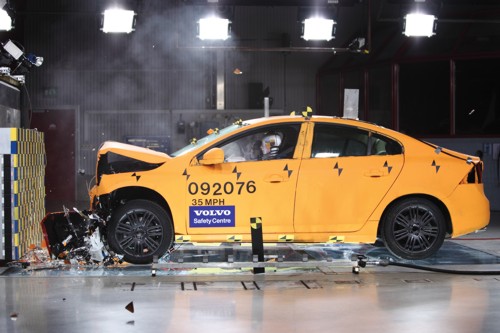
 Sweden’s
last remaining carmaker has a justifiable reputation
for the excellent safety of its cars, even by today’s
very highest European standards.
In the unlikely event of being involved in a car
accident, most motoring journalists, given a choice to
pick an affordable non-premium brand model for the
experience, would probably choose to experience such a
crash in one of Volvo’s recent models.
None of this ranks as classified information.
Ask Joe Public to rank today’s car brands by safety,
and you’ll probably find Volvo near the top of their
list.
And yet, in the cold light of day, none of that
matters in the world’s car showrooms, least of all in
today’s still prevailing snob-culture. In this
respect, China’s nouveau-riche probably take the top
ranked position.
Safety, that’s the safety record or reputation of a
particular carmaker like Volvo, doesn’t appear to have
any, or at least little clout in the car purchase
decision of today’s well-to-do in China.
Consumer sentiment in Europe, judged by Volvo’s
slightly worse than average car sales performance in
this year’s contracting West European car market,
appears rather similar.
Why?
Chiefly because label or badge-culture appears
rampant.
And not just in today’s iPhone generation.
A trendy badge conjures up all the right images –
even if the trendy nature of the mere label or the
badge often proves more potent than the actual
substance of the product itself.
As it turns out, China’s rich, probably more than any
other nation at present, appear more concerned at what
their newly acquired car says to the world at large
about their social status and the size of their
wallet.
That means that high-image cars from top-notch premium
car makers are bought chiefly on the image strength of
their high-status badge.
As it turns out, for all those with deep pockets, the
sky-high price of these wheeled status symbols appears
no barrier.
Paradoxically perhaps, the higher the sticker price of
these status-symbols, the higher the appeal.
That means that fully built-up luxury car imports such
as Porsche’s Cayenne, BMW’s 7-Series or Audi’s A8 for
instance, which attract the full force of China’s car
import duty, have been all the rage with China’s
status-conscious wealthy.
So much so in fact, that Mercedes and BMW now sell
more of their top-notch German-made stretched luxury
limos in China than anywhere else.
None of that is new.
To an extent, some of this sentiment was already
echoed in no less showy Japan during the peak years of
Japan’s infamous bubble economy.
Whilst Japan is a market for right-hand-drive cars, a
large proportion of Mercedes S-Class buyers in Japan
opted for the left-hand-drive version, because that
way it stood out instantly as exotic and pricey in a
market where 99.9% of all new cars are of course right
hand drive.
Deeply recessionary Japan has changed a great deal
since, but in this respect – showing off one’s
financial worth by way of the car owned, China appears
to have taken up the baton.
When Ford’s hard-nosed US decision makers decided to
jettison their earlier acquired Volvo car manufacturer
to the highest bidder, a tiny and comparatively
inexperienced Chinese car manufacturer decided to take
the reins.
And as with Rover before, which was given far too much
initial freedom and leeway by its Munich based BMW
owners, Chinese car maker Geely, which owns Volvo
Cars, also left its new acquisition with too much
leash.
As it turns out, widespread earlier expectations of
flourishing Volvo sales in Geely’s domestic Chinese
home patch have blatantly failed to materialise.
If anything, Volvo’s performance in China probably
ranks as one of the market’s greatest disappointments.
By any measure, Volvo’s woeful showing in this
year’s Chinese market bears testament to that.
Recent developments best sum up Volvo’s poor
performance in China’s still flourishing prestige
sector market.
Particularly so when considering that it is now fully
owned by one of China’s own carmakers.
During the eleven months to November this year, made
up of both locally assembled and fully built-up
imports, Volvo sold just 37,600 new cars in China.
Put into perspective, that’s the number sold by Audi
in China during November alone.
It brings Audi’s eleven months sales in China to
295,974. Yesterday’s Financial Times summed it up
nicely when saying “Volvo to shift up a gear in
China”.
The way things stand at present, High time for
Volvo to shift up a few gears in China, would have
summed it up even better.

To continue reading this article, please register
for a free sample without obligation...
Please note that
eagleAID.com is a subscriber-only site, and as such it can
only be viewed by subscribers to the newsletter.
|

