€
= available to
all Newsletter subscription members via email, hard-copy or download.
Non-members may purchase individual articles by credit card:
click
here
for contact
details.
|
| € |
EDITORIAL
India - Is future promise worth the wait?
AID Newsletter
Editorial
1403
from Peter Schmidt -
February 19th 2014
 Demand is not only the stored up desire to own something, but also the willingness and ability to pay for it.
India clearly scores high on the former, but less so on the second.
Recent developments in India’s car market have been disappointing.
Whilst India’s own Tata has already run aground, Hyundai has continued to sail on serenely.
But there is no knowing the extent of its recent sales push efforts.
India’s car market had been touted to become a significant growth market thanks to its impressive growth record and above all its vast population.
But far from following the same or even remotely similar path as China, which continues to forge ahead at a faster than earlier predicted pace, so far at least, India’s car market continues to languish in the starting blocks.
Moreover, while China’s car sales mix has turned out a great deal richer than even optimists could have expected during the late 1990s, India’s new car market consists almost entirely of inexpensive small cars with few frills.
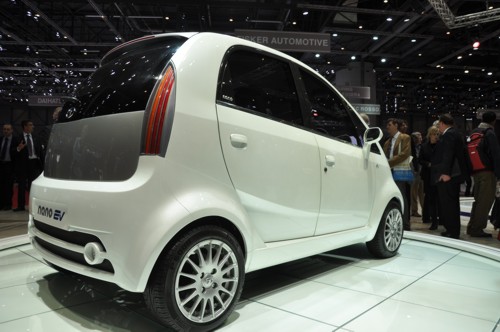
Yet paradoxically, the cheapest car yet devised by the industry for just such a market - the previously much talked about Tata Nano - stands out as a high-profile flop.
Contrast that with Suzuki’s long trusted tiny cars that are still responsible for half the cars sold there.
Underlying trends?
Last year’s Suzuki’s sales share rose 6 percentage points, while Ford’s car sales share in India almost halved, slipping to a mere 2.5 per cent from 4.3 per cent only the year before.
Moreover, Nissan, after only recently entering India’s car market with high hopes, appears to be doing little better than Ford. It too suffered a devastating 47.1 per cent dip in last year’s sales, chopping its market share to 1.3 per cent from 2.2 per cent only the year before.
The bare knuckle fist fight for sales is such that even Skoda, a comparatively long established campaigner in India, saw last year’s sales plunge by more than a third to some 20,700 units.
So how about a recent arrival such as Volkswagen?
Last December it assembled just over 4,000 of its cars in India.
The vast majority of these - 3,800 - went for export.
It suggests that the bulk of its December sales in India - 3,000 - came from bulging stocks of unsold cars.
Compare that with China.
By measure of magnitude, in China the VW brand sold almost quarter of a million cars last December alone, made up in the main of Golf-class cars.
China’s car market went from strength to strength, with annual passenger car sales zooming from less than a million as recently as 2001 to 3.2m in 2005 and a sky-high 14.8m last year.
While China continued to steam on at express pace during recent years, India’s car market, after growing encouragingly during the mid to late 2000s, has clearly hit the buffers.
In the early to mid 2000s, India was selling around 800,000 passenger cars per year.
Following encouraging growth since then, today India sells closer to two million cars.
Even without imports, last year’s new car sales in China rose by 2.3 million to 14.8 million units.
In India, it is not only foreign carmakers that are now taking a beating.
Long established domestics are also suffering.
None more so than Tata.
Its woes are summed up by the sobering realisation that it currently ranks as the market’s biggest casualty.
Last year’s domestic car sales more than halved to less than 108,000 units.
Its full year market share slumped to 5.9 per cent from 11.6 per cent only the year before.
Clearly, with few notable exceptions such as Hyundai, which also ranks as India’s way and ahead biggest exporter of cars, most of India’s terrified autoindustry is now saddled with a huge chunk of idling surplus capacity.
Adding to their misery, the recent steep slide of India’s rupee on currency exchange markets has greatly inflated the cost of vital imported parts and major assemblies from their plants in dollar or euro regions.
A survey of the winners and losers in India’s bloody car sales wars shows that even some of the companies that acted early and aggressively to set up their stalls in India have not been spared the piercing pain from today’s fallout.
On the bright side however, there is a broad consensus that the available opportunities offered in India’s market in the medium to long term are worth the pain and bloodletting suffered at present.
At least for those who can afford to take the hit.
To an extent however, in light of recent setbacks, India’s stalled car market has echoes of Brazil, which was long seen as the country of the future.
As with Brazil, for India too no one really knows when that future really comes.
Judged from recent developments, it’s probably wise to prepare for a long
wait.
MORE
LIKE THIS:
INDIA
| Troubled Tata falls back to earth 18 Feb 2014
India’s car sales just keep tumbling
12 Feb 2014
EDITORIAL
| BMW is right to have a foot in both camps, payback may take longer
18 Dec 2013
Please note that
eagleAID.com is a subscriber-only site, and as such it can
only be viewed by subscribers to the newsletter.
|
|

